
chronicle: the early history of salt
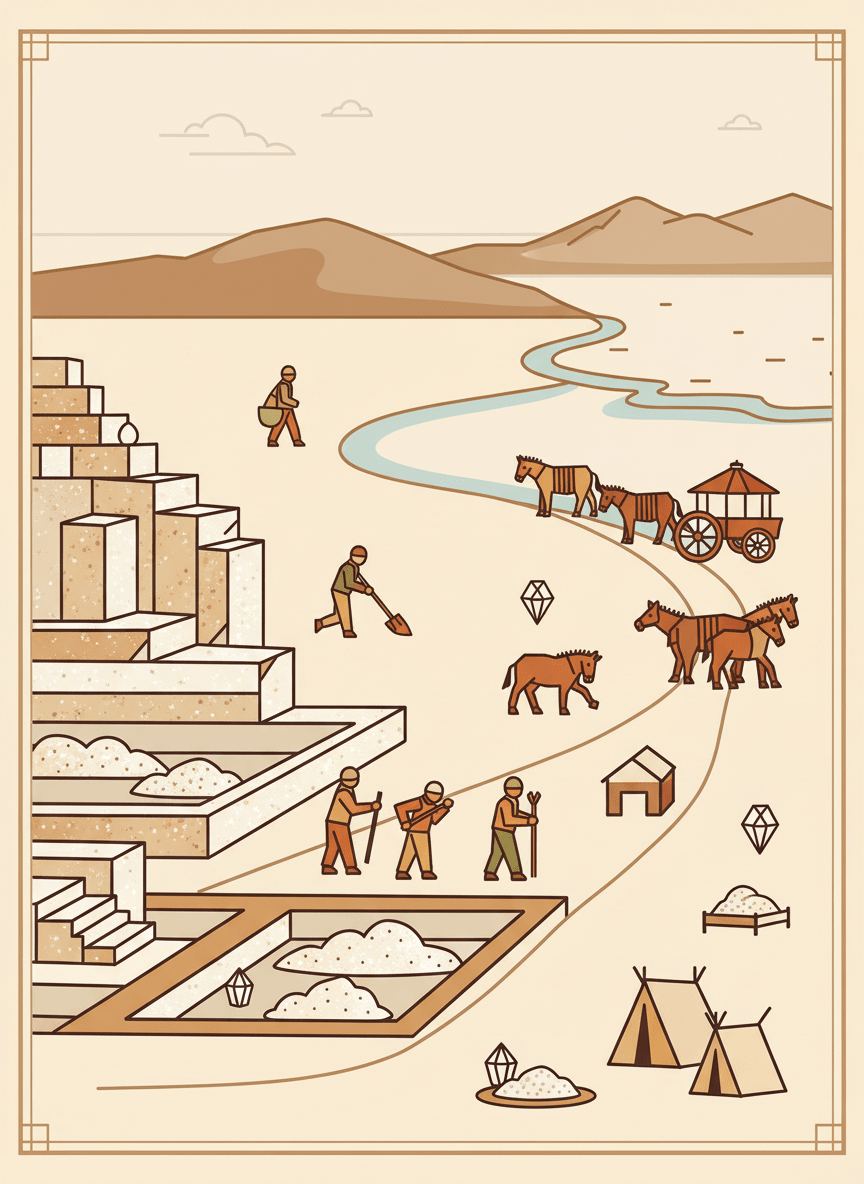
Salt, often seen as humble, is anything but ordinary. For most of human history, this unassuming crystal was chased and fought over like gold. A small chemical miracle, formed from a volatile metal and a poisonous gas, salt is a rock humans regularly eat and cannot live without. Long before it seasoned food, salt preserved life itself. As humans shifted from hunting to farming, salt quietly became a necessity, binding survival and civilization together in a way few other compounds ever have. Leaving its trace everywhere from ancient salt lakes to the origin of “salary”.
If those little white grains in shakers in kitchens and on dining tables all over the world could talk, what a story they could tell. Salt has been sought and used by humans since before the dawn of recorded history. While today it is an inexpensive and widely available commodity, for much of human history that was not the case. In fact, it was for centuries a highly prized and expensive luxury. At different points in the human story, salt has been used as money, a food preservative, an object of religious and magical ritual, a seasoning, and even as we shall see in a later entry, a building material.

A Vital Rock: Essential & Edible
While later we will also discuss the many forms of edible salt, the table salt most people are familiar with is sodium chloride (NaCl), which is strangely made up of a volatile metal (sodium) and a lethal gas (chlorine), which together create in essence an edible rock. Salt in its various forms is the only regularly consumed rock in the human diet.
Salt isn't just important to humans because of its taste. The human body needs salt to function. When our carnivorous ancestors were living on the meat they could hunt or forage, their diet alone gave them adequate salt for their bodies. However, when humans developed agriculture and moved towards civilization, the increasing plant diet did not satisfy the amounts of salt the human body required and forced our ancestors to procure salt for themselves.
Ancient China: Turning Water into White Gold

The earliest known human salt extraction goes back to ancient China around 6000 BC.
There a salt lake named Yuncheng (yoon-CHUNG) in the Shanxi (shahn-shee) Province attracted a lot of attention. In the dry season, water from the lake would evaporate leaving large salt flats exposed to the air. The salt not only attracted people to settle near Yuncheng, but control of the lake seems to have led to much organized warfare. The Chinese were also the first known to heat brine water in ceramic vessels, thus evaporating the water and leaving the salt behind. Eventually they would develop advanced salt production methods using bamboo tubes and heating pans.

Stone Age Europe: Following the Herd
In Europe, our stone age ancestors seemingly met their early salt needs by following animal trails to salt licks (animals love and need their salt too) or using primitive methods such as pouring brine directly onto smoldering embers to evaporate the liquid from the salt.
Later techniques involved using simple clay rectangular salt molds called briquetages (brih-KEHT-ahzh) to heat the water from the brine. Some early coastal dwellers may have soaked their greens in sea water to get a saltier taste.

Mesopotamia and Egypt: Fish & Pharaohs
Salt was critical in the rise of the two great ancient near eastern civilizations of Mesopotamia, which was centered around the Tigris & Euphrates rivers, and Egypt, which hugged the banks of the Nile.
The Mesopotamians were extracting salt as early as 3000 BC, and both civilizations mastered forms of food preservation using salt. Both were in desert climates where food, especially fish, would spoil quickly without it. Salt making is depicted in Egyptian art and mentioned on Mesopotamian clay tablets in their distinctive writing system called cuneiform. Both civilizations employed salt as a prized trade good and in some cases used it as a form of currency. Egyptian salted fish became a major export item. Perhaps the most memorable use of salt in ancient Egypt was for drying and preserving bodies for mummification.
Phoenicians: Merchants of Salt & Color
The Phoenicians, a civilization of great maritime traders who incidentally also gave us the modern alphabet, trafficked salt and salted meat products across the Mediterranean world. The Phoenicians also invented a kind of purple dye made from the glands of sea mollusks that became a highly sought-after and expensive luxury in the ancient world which would go on to grace everything from emperor's togas to legend has it, the sails of Cleopatra's boat. The production of this prized dye was only possible by mixing snail mucous with, you guessed it, salt.

Greece and Rome: Seasoning an Empire

With the rise of the Classical civilizations of Greece and Rome, salt was a mainstay of culture. Hippocrates, who is known as the Father of Medicine, advocated an early mouthwash to treat bad breath from salt, vinegar and alum (I'll stick with the minty freshness of the modern era). As a unit of trade, salt was sometimes bartered for slaves, which led to the expression "worth his salt." Rome, who created the largest civilization the world had yet known, depended on salted pork and fish to feed its vast legions. Salt was so valued by the soldiers that part of their pay was in a salt allowance called a salarium, the origin of today's word salary. The Romans also used salt, combined with a nauseating range of fish parts, blood, and entrails, to create a much-loved fermented sauce called garum (GAIR-um), which is not unlike modern fish sauce in Southeast Asia. The Romans also prized a salty taste on their leafy greens, which gave rise to the word salad.
The Carthage Rumor: Did Rome Really Salt the Earth?
Salt too appears in a great Roman historical myth. Rome, while it was still a republic, fought a series of three brutal wars with their archrivals, the Carthaginians in North Africa. These conflicts, now referred to as the Punic Wars, ended when Rome demolished the city of Carthage in 146 BC. A legend arose that to really signify their enemy's end, the Romans sowed salt into the Carthaginian fields. However, this is almost certainly untrue given the value of salt in the age of the Romans. Similarly, if a Roman happened to travel through space and time, they would undoubtedly be aghast at our habit of pouring tons of salt onto our roadways to melt the ice. It would seem to them like pouring money itself right onto the roads!

Next up, we'll look at the other spices that were making a name for themselves in the ancient world.
